FEATURE: “The Little Visitor” by Vincent H. O’Neil
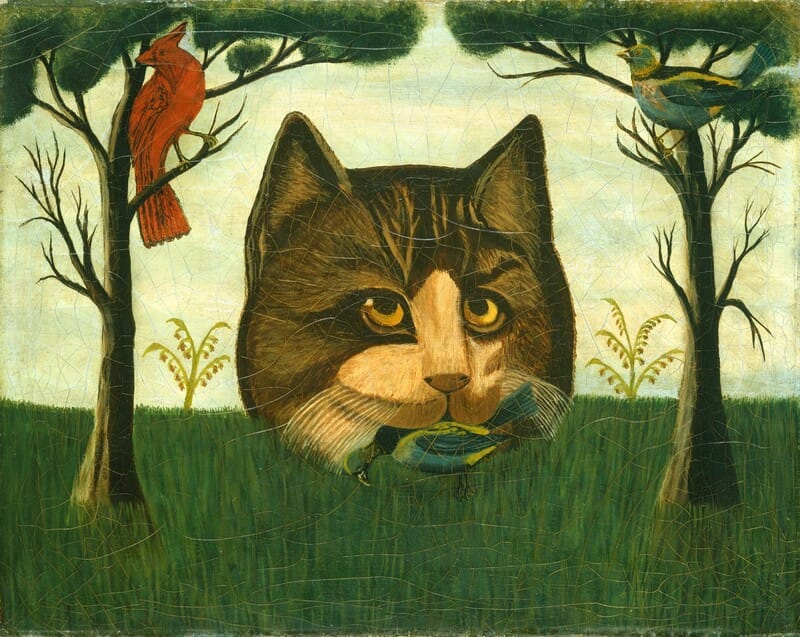
It wasn’t even Ted’s cat. It belonged to his wife Wendy, who had been staying at her mother’s place for so long that Ted was beginning to consider her his ex-wife. They’d quarreled over something stupid, as they had all winter, and she’d left two weeks before. Wendy’s mother was allergic to cat hair, but Ted liked his wife’s pet and hoped it might be a reason for her to return. So that was how he came to let somebody else’s cat into an otherwise empty house that night in early spring.
The cat’s name was Elsa, as in Elsa the lioness even though she didn’t resemble the lion in the movie. Jet black with yellow-green eyes, she liked to spend the early evening prowling the vast expanse of woods that bordered their back yard. She was a thankfully neat and quiet cat, and slept on his ankles instead of Wendy’s now that his wife was not with him in the big bed upstairs.
Later on, Ted would rack his brains trying to remember if Elsa had been wearing her collar when she came in that particular evening, but the truth was he hadn’t even looked at her. He’d brought some work home, fiendish database stuff that simply wouldn’t cooperate, and so was lost in thought when he checked to see that the cat had water before returning to the study.
He finally turned in around midnight, expecting to sleep soundly. He did, too, except for a brief moment when he rolled over and came face to face with the silly cat. It was wide awake, crouching not six inches from his head, and staring at him intently. Ted drifted off again almost immediately, wondering vaguely why the beast was not asleep on his legs.
It was the next day before he noticed that Elsa wasn’t wearing her bright red collar, but he didn’t catch on to this right away. Hustling around the kitchen preparing a quick breakfast, Ted caught a glimpse of the feline as she sniffed at her food bowl. For a moment it seemed he was looking at a completely different cat.
At first he wasn’t sure what made him think this, but on closer inspection Elsa appeared somehow bigger. He was still studying her features when Elsa flashed her eyes up at his, moving so abruptly that Ted actually looked away. He felt for a moment as if a total stranger had caught him staring, but when he looked back he noticed the absence of the collar. That must be it. Her collar was missing.
“Oh, Wendy’s not gonna like for that.” Ted muttered. The problem was not so much the collar as the identity tag, which Wendy believed was Elsa’s only protection against being gassed in an animal shelter. He had no idea where his wife had gotten the medallion, and replacing it wasn’t going to be easy.
Putting his cereal bowl in the sink, he headed out the door with the parting thought that the collar might have come off inside the house. He hoped so, and spent the entire commute trying to remember if he’d seen the red neckband when Elsa had come in the night before.
Of course he’d forgotten about the collar by the time he came home, but he remembered soon enough. The answering machine was blinking when he came through the door, and he hit the button in the weak hope that it would finally be Wendy. The message turned out to be blank, but he stood and listened to it anyway, imagining his wife on the other end trying to find the words. He erased the message, and turned to look straight into the narrow eyes of the cat.
Elsa had been watching him from on top of the refrigerator the entire time, not a foot from his head, and Ted took a step back in surprise. The cat usually regarded him with wide, interested eyes, as if fascinated by whatever he was doing, and yet the face regarding him now showed nothing like that. Elsa’s eyes were narrow and malicious, and Ted decided that he was being treated to the same look that she gave to unlucky field mice. Thinking of the animal hunting outdoors reminded him of the missing collar, and he slowly approached to make sure that the neckband was indeed gone.
She jumped from the refrigerator just as he reached to smooth back her fur, landing on the linoleum in a posture that suggested flight. Baffled by this unusual behavior, Ted looked at her for several seconds before deciding that she was probably just anxious to go outside.
“Wanna go out?” Ted was surprised that he had to ask. Most evenings Elsa met him at the door, did a few figure-eights around his ankles, and then began mewing her desire to get some air. He stopped pondering this when she hustled across the kitchen and stood expectantly at the back door. He let her out and looked toward the living room, trying to think of the various places where the collar might have gotten lost.
He had no luck locating the small leather strap, even when he looked in the basement. Elsa frequently spent time in the cellar, having learned to spring the doorknob by jumping up and clawing at it, but she hadn’t lost the collar down there.
Ted wondered if this might be a good pretext for calling Wendy. Asking where she’d bought the ID tag seemed innocent enough, but then he remembered his phone call of a week before. Her mother had tried to tell him Wendy wasn’t there, but his wife had suddenly come on the line, angrily saying she would call when she was good and ready. This disagreeable memory was playing in his mind as he came up the basement steps, but it vanished when he heard the scratching.
Clawing was more like it, and it was coming from the base of the back door. He immediately thought of Elsa, but she never scratched to be let in. No, this was something else, and the harsh scraping suggested a wild animal trying to rip through the wood. Ted stood frozen halfway up the cellar steps, staring across the linoleum, his eyes on the same level as whatever was making the noise. The curtains on the door’s window vibrated with the long, angry rasps.
What could it be? A raccoon? Maybe a rabid one?
The thought of rabies startled him, because it might explain Elsa’s strange behavior earlier that evening. He had no idea how long the disease took to incubate, but what if the cat had been bitten the night before? What if that was how she’d lost her collar?
Ted made himself walk toward the sound, but he stopped halfway across the kitchen. If Elsa had indeed gone mad, there was no way he could let her in the house. But what else could he do? Wendy would never forgive him if something happened to her pet. He took another step toward the scratching, and this time the thing heard him. It stopped with such suddenness that all he could imagine was some nocturnal predator out there, poised to jump at him the second he opened the door.
Praying that the boards beneath him wouldn’t creak, Ted stepped up to the door and pushed back the curtains. He strained to see downward, but was unable to make out the shadowy form now frozen not six inches from his foot. What was it? And why was it trying to get inside? He pressed his cheek against the cold glass, but it did no good. He was considering which household tools might be used as weapons when he remembered changing the outside light bulb just a few days before. He kept his eyes on the shadow while reaching for the switch, hoping to see the thing before the light frightened it away. Hoping the light would frighten it away.
Elsa was staring at him when the beam hit the stoop. The eyes that looked up at him were the old round Elsa eyes, and the face was the same old quizzical Elsa. Ted shook his head, chiding himself for getting so far along with the crazy rabies story. As if in contrition, he leaned down so he could pet the cat as it entered. He did touch it briefly, but only long enough to see that Elsa was dragging a mangled, bloody mass of brown that almost looked like a rabbit.
The shout that came out of his mouth was short, involuntary, and loud. It wasn’t really a word, but the cat knew what it meant and began furiously waddling across the linoleum with its load, streaking the yellow floral pattern with blood. She was trying very hard to get the corpse into the living room, and Ted’s only chance at stopping her was to reach out and grab the mangled body.
He snatched for it and caught a limp leg, but the cat turned and lashed out at him with a paw that was sickeningly red. Ted jumped back in fright, letting go to avoid being scratched, utterly astounded by the animal’s response. Elsa had never tried to scratch him before. They stood there for a moment, glaring at each other over the bloody trophy, before Ted’s revulsion made him act and he took a heavy step toward the cat. With a loud growl it gave up the fight and ran off into the house.
The shovel handle was old, and Ted cut his hand on it before the hole was half finished. While wrapping a handkerchief around his bloodied palm, he got a good look at the rabbit’s carcass. Something had practically ripped it in half, and he just couldn’t bring himself to believe a house cat could inflict that kind of damage.
Did cats even kill rabbits? Could they? And if they could, would they tear the victim apart like this? Was it possible that some other animal had killed the rabbit and Elsa had come across it afterward? But what animal would kill a rabbit and then leave it behind?
A dog. Ted remembered a dog from his childhood, a big neighborhood brute that had killed a cat in much the same way. He stopped digging and regarded the broken form at the edge of his yard, nodding as if trying to convince himself. Had to be a dog. A dog would leave the remains behind, too, so that explained how Elsa had ended up carting the thing home. Ted used the shovel to tip the carcass into the hole, and quickly covered it up.
Looking up, he thought he saw the cat’s shadow leap down from the living room’s bay window.
He reentered the kitchen through the back door, half expecting to see Elsa waiting for him. She was not, but when he looked all around the kitchen he noticed that she hadn’t touched any of the dry food set out for her that morning. Elsa had a healthy and predictable appetite, and he wondered again if she might be sick.
“Well, there’s one sure way to find out.” He said aloud as he opened a cupboard and took out a can of tuna. He’d just broken the seal when he heard the scrape of claws on the linoleum, and he turned to see the cat in the middle of the floor. Elsa’s eyes were wide in expectation, and he told her to wait just a second as he chunked up the fish and then set it down for her.
She lunged at the food, wolfing it down in big bites. Even though she was done in a matter of seconds, Ted had the chance to get a good look at her in the light. It wasn’t a comforting inspection, as he became certain that Elsa was much larger than he remembered her. She still wore the thick coat developed over the winter, but that wasn’t it. She was definitely bigger.
Elsa looked up when the food had vanished, and flinched suddenly when their eyes met. She didn’t move away from the plate, but Ted got the impression that she had completely forgotten him while eating. Keeping his eyes on her, Ted reached for a second can of fish and saw the cat lean forward eagerly.
That was when he remembered letting her in the previous night. Most nights Elsa would come to the back door and mew until admitted, but the prior evening he’d been forced to call her. Ted now recalled the form slouching out of the darkness toward him, and almost dropped the empty tin when the realization took hold. The animal eating in his kitchen was not his wife’s cat.
The beast made itself scarce when the tuna was gone, and Ted felt relieved to have the interloper out of his sight. He went upstairs to his study, his head spinning with the consequences of his belief. What were the odds of a feral cat, nearly identical to Wendy’s, coming into his house at all? What were the odds of that happening on the same night that the original cat failed to come home? What had happened to Elsa? And finally, if he was right about this cat not being Elsa, what was he to do with it?
He had half a mind to simply shoo it out of the house, but there was still the nagging possibility that he was wrong. Although Ted doubted that, he couldn’t imagine explaining it to Wendy without letting her see the animal herself.
“Maybe I should let her see the rabbit.” He muttered. “That would do it.”
It was getting late, and Ted decided to turn in. This unfortunately reminded him that the strange cat had slept inches from his face the night before, and he shivered at the very thought.
He walked around the second floor looking for the animal and, failing to find it, started downstairs. The kitchen light was the only one left on, and he felt a childish dread as he approached the foot of the darkened stairway. Although the cat had seemed friendly enough when eating, Ted couldn’t forget the image of its bloody, swiping paw when he’d reached for the rabbit. The question of rabies popped into his head again, and he imagined a crazed ball of fur leaping at him from the shadows as he stupidly walked around calling out the name of a cat that wasn’t there.
In an unsettling reversal of his usual nighttime routine, Ted began turning on the various lamps as he checked each room for the stray. Remembering his fright at coming face to face with the strange feline that afternoon, he caught himself looking up at the tops of bookcases and shelves while fumbling for the switches. Though each new illumination showed nothing, this didn’t calm him. He had no idea where the animal was, or what it might do.
He’d covered the entire ground floor before noticing that the basement door was open a crack. He put his hand on the door knob as if to go down, but then considered the cellar’s only light. It was a bare ceiling bulb activated by a pull string, several feet from the bottom of the steps. The thought of descending into the darkness, his ankles exposed on the unfinished stairs and his arm reaching blindly for the string, made him leery of making sure the cat was actually down there. He’d already checked the rest of the house, so where else could it be? If he went down there, it might follow him upstairs in the expectation of sleeping in his bedroom again.
He fought off the impulse to shut the cellar door, feeling it would be unfair to trap the beast when it was already staying out of his way. He wasn’t as successful fighting off the urge to shut the bedroom door, though, or to tip a chair up against it for good measure.
He slept badly, dreaming of a small animal fighting for its life against a large predator somewhere in a dark forest. The scene before his eyes jerked and jumped as if he were the victim, one moment tossed across some wet leaves and the next being flipped into the air. He caught a momentary glimpse of the towering monster killing him, and somewhere in his dream state Ted recognized it as the dog from his childhood, the one that had killed the cat. It was truly a glimpse, though, as the view suddenly went pitch black. Asleep, he imagined he was playing dead to make the attacker leave him alone.
Even that lasted but a moment, as his eyes opened on a sideways view of the ancient stone bench in the woodlot behind the house. From the angle of his vision he figured he was lying on his side, but the trick seemed to have worked. The dog was gone and he was alive. Dazed, he rolled halfway into a sitting position and looked down to see the blood-matted black coat of a badly wounded cat. Elsa.
Following some freakish dream logic, he raised an injured hind leg and hooked it in the unseen collar around his neck. After struggling for a few moments, he finally freed himself from the neckband and saw that it too was covered in blood. The dream began to fade just then, but it lasted long enough for him to obey the unspoken command to put the collar on the bench. His grievous wounds were healed that instant, and it was with a feeling of bizarre vitality that he hustled off through the trees toward the lighted house in the distance.
Ted had forgotten to set the alarm, and awoke the next day with little time to get to work. Although the cat didn’t show itself while he rushed around grabbing his things, Ted still felt great relief when he got out the front door.
He returned from work with some semblance of a plan. Regardless of her reaction to his call, Wendy was going to have to see the cat before he could kick it out. Ted had no idea how to begin such a conversation, and had spent much of the workday puzzling over it. Parts of the previous night’s dream had come back to him during his ruminations, suggesting he go look for Elsa’s collar before calling Wendy. He didn’t expect to find it, but wanted to be able to tell her he’d tried. Ted’s analytical mind gave no weight to dreams, but he had to acknowledge a nearly compulsive desire to get a look at the stone bench in the woods behind the house.
Pulling into the driveway, he scanned the front windows for any sign of the cat. Not seeing it, Ted chalked up one more piece of evidence that this was not Elsa, who often came to the window when a car pulled up. Getting out, he walked around the house and started across the backyard toward the trees beyond.
The bench was a good hundred yards inside the dense woods, and so the surroundings began to look more like winter than spring. A carpet of dead leaves, flattened by the snow and drenched by the thaw, seemed to cover every inch of the ground not claimed by the trees. Ted couldn’t help remembering that he and Wendy had sometimes sat together on that bench when taking evening walks in happier times.
Looking at it, Ted noticed for the first time that it might not have been a bench at all. The size of a small sofa, it was a rectangular stone squared off by human hands decades, maybe centuries, before. It sat on a small rise, and Ted involuntarily imagined the area as a clearing with this seat, this altar, in its center. The thought made him shudder, but the dream images from the night before wouldn’t leave his mind.
Climbing the knoll, he turned around slowly until satisfied that Elsa’s red collar wasn’t in plain sight. The dream had put her at the base of the rise, so he went back down and began searching. Ted hadn’t been at this long when several birds, silent until then, took up a strident chirping overhead. Looking around, he saw what was frightening them and understood the feeling.
The black cat was hustling toward him across the leaves, but something about it was wrong. He squinted in the gloom, but the animal was almost on top of him before Ted finally recognized the item it was carrying. Eight inches long and pink in color, it was one of Wendy’s hairbrushes. It had been sitting on her bureau that morning.
An unidentifiable sense of alarm surged through him as the dark feline reached the base of the knoll and began to climb. It couldn’t have missed seeing him, and yet it gave no indication of his presence. Ted’s heart began beating harder, and he felt the coolness of the late afternoon air as if the temperature had dropped precipitously. His mind raced as he watched the cat bounce up the rise: What was it doing with Wendy’s hairbrush? How had it gotten outside? Why didn’t it see him?
The cat reached the bench and hopped up so its two front paws topped the flat stone. Like a dog returning a stick to its master, it placed the plastic item on the rock and then dropped back down. Turning in a tight circle, it lowered its hind legs to the earth and sat motionless, as if waiting for something. The chills going through Ted no longer had anything to do with the temperature.
Whatever it was hoping for, the cat seemed to get it after only a few seconds. It gave off a disgusted, frustrated cough before retrieving the brush from the seat and turning to look directly at Ted. It leapt in fright, jumping sideways and scattering leaves everywhere before streaking away through the trees.
Ted wanted to chase after it, but he’d seen the hairbrush fall from the animal’s mouth and had no intention of coming back to retrieve it. Not in the dark, anyway. Running up the rise, he bent over to grab the brush and saw what he’d been looking for originally. The very tip of Elsa’s red collar protruded from the leaves at the base of the bench, and he disturbed more of the compressed humus when he reached for it. Buried right next to it, probably that very afternoon, was the handkerchief he’d used as a bandage the night before. Dried blood spotted the white fabric, and Ted saw a similar stain on the cat’s collar.
One of the cat’s belongings, one of his. Each touched by its owner’s blood. That was why Wendy’s hairbrush wasn’t acceptable to whatever force was animating the cat. No blood.
Clutching the collar and the handkerchief, he raced off through the gathering dark.
Ted came to a dead stop just after bursting through the back door. The kitchen was different. It wasn’t a total mess, but the disarray on the counters suggested that the hairbrush wasn’t the first item the cat had brought out to the woods.
The hairbrush. Ted took the stairs two at a time as he charged straight for the bedroom. The demented beast was up on Wendy’s bureau, its head stuck in the open lid of her jewelry box. He lunged across the floor at it, but the animal timed its escape perfectly. In a single swift movement it lunged under his swinging arm, one of Wendy’s ornate pins in its mouth. It was out the door in a flash, and he barely kept it in sight as he pounded back down the stairs. The cat shot through the tiny space created by the cellar’s open door, vanishing into the shadows.
So that was how it was getting outside. The back door had been locked and all the windows were closed, so it must have found an exit in the basement. Or clawed one the night before. Ted processed this even as he was thumping down the cellar steps, propelled by an instinctive need to stop the animal from getting outside with the brooch.
The basement’s tiny ground-level windows let in enough light so that he could see the exit hole the cat had clawed in the wood, and Ted surged toward it from the bottom of the steps. It was exactly what the beast was waiting for.
It flew off the hot water heater, claws sinking into his back, just as he hit the stone floor. His shock at the ambush was so great that Ted kept going, spinning out of control while the furry razor machine tore at his neck. He slammed into a brick pillar and saw stars, but the impact knocked the cat off of him for an instant. It was back almost immediately, leaping straight for his eyes with a roar like a tiny lion. His left arm came up at the last second, and only one claw tagged him, scoring his cheek like a whip.
Ted’s heart was pounding, and he could feel blood running down his back. Adrenaline shot through him alongside the realization that the fiendish cat had actually wanted to get him down there. He backed against the pillar, acutely aware of the tight confines and the darkness, his eyes searching wildly for his attacker. The frenzied brute had dashed behind the water heater upon hitting the floor, and the way to the stairs was open again. Seeing the light in the kitchen, he lunged for the steps as if the basement was on fire.
The monster flew between the planks of the open stairwell just as his foot touched the bottom step, landing on his chest and driving its claws right through his shirt. He actually screamed this time, grabbing the thrashing, slicing form with both hands as he lost his balance and went over backwards. The hard floor knocked the wind out of him, but his flailing legs kept going and he flipped over onto his stomach.
The horrible bag of razors in his hands gave off a shriek when he landed on it.
Ted buried the monster next to the spot where he’d interred the rabbit. The sky had turned black before he could finish cleaning the ugly scratches on his chest and back. He’d covered the one visible mark on his cheek with a band-aid and then gone through the house, putting everything back the way it had been before the little visitor had gone on its scavenger hunt.
Tipping the body into the hole, he turned on his flashlight and inspected it one last time. It seemed much smaller now that it was dead, and its staring eyes were the familiar orbs of Elsa the cat. Just before he covered it up, he dropped her collar into the hole.
Ted waited a few days before calling Wendy. The scratches had healed with surprising speed, but it had taken him a lot longer to decide what to tell his wife. Certain that no sane person would believe his tale, he finally decided to say only that Elsa was missing. Wendy tersely interrogated him just long enough to learn that her cat had disappeared during one of its nocturnal walks, and then hung up.
That was why Ted was so surprised when he heard the knock at the back door. He recognized Wendy’s silhouette when he turned on the outside light, and had only a moment to think about the last time he’d opened that door before his wife was in his arms, crying as if she would never stop. Her blonde hair was damp and there was mud flecked on her pants and shoes.
“I’m sorry, I’m sorry, I’ve been just horrible to you, I was out in the woods looking for Elsa …” She trailed off, and they stood there rocking gently. “I was out there so long, I was so tired, I cut my leg on something, I finally wound up on that rock where we used to sit.”
His stomach knotted up, but she went on before he could speak.
“And all of a sudden I saw what I’d done to you, I was looking for the silly cat but pushing you away, I was out in the woods when what I wanted was right here.” They kissed, and he barely got the back door locked before she took him up to their bedroom.
Ted inspected the small cut on his wife’s leg that night, and told himself that the thin crimson line couldn’t have bled much when Wendy had sat on the stone bench in the woods. He told himself a number of things to explain her strange lack of concern for Elsa’s whereabouts the next day, when life seemed almost back to normal. The day after that he told himself that he’d thrown away the disposable razor, the one that had nicked him the morning after Wendy’s return, even though he knew he hadn’t.
Later he told himself that some animal, a dog perhaps, had dug up the dead cat that he’d buried a little too close to the woods a week before. He told himself something similar the next day, when he came home from work to find a large black cat sitting on his doorstep. It wore a bright red collar smudged with dirt, and looked at him with narrow eyes.
He told himself that Wendy would be pleased to see Elsa, and opened the door for the creature to enter.
Vincent H. O'Neil is the Malice Award-winning author of the Exile mystery series from St. Martin's Press and the military sci-fi Sim War series (written as Henry V. O'Neil) from HarperCollins. His short work has appeared in Parsec, Andromeda Spaceways, Bourbon Penn, Lovecraftiana, and other magazines. His website is www.vincenthoneil.com